The Audit Pre-Planning Checklist
A 5-step framework covering business understanding, stakeholder alignment, resource allocation, and scope management before launching an audit.
Most auditors can complete the work. Few can explain the thinking behind it. I write to help you build that judgment in IT audit.

I didn't plan on audit. I had software development experience. Coding never interested me.
My undergrad introduced me to Information Security Management Systems. That's where audit as a career first showed up.
Back then, in India, there were barely any resources to learn it. So I did what was available. Certifications. ISO 27001 was one of the first.
Eight months. Fidelity Investments. IT audit intern.
I had already done my CISA before this. All theory.
This was different. Walkthroughs. Planning meetings. Workpapers. A checklist, handed to me, to complete.
Years later, I sat in meetings with auditors who had ten, fifteen years of experience.
They were excellent at the checklist. Then the conversation would shift.
An exception. A configuration issue. And one question: why should the business care?
Silence.
Application control audits, mostly.
Application controls don't come with general guidance. Every organization is different. So you're forced to ask: what if this control doesn't work? What would actually go wrong?
Review comments taught me the rest. How you document. How you narrate a risk. That matters more than the checkbox.
Audit is the third line of defense. Independent assurance. That's the whole point.
Right after the internship. I was struggling to find context for what I was doing.
Later, AI made information easy to find. But information was never the real problem.
You can look up what change management is. You can't look up what to do when an emergency change wasn't documented, and the business needed it to survive.
That only comes from living it.
Assistant Vice President, Internal Audit, Barclays. The other side of the table now. Closer to the business.
The goal is simple. Keep sharing what I've learned. Build the Audit Hub into the place people actually go to learn judgment, not just theory.
Everyone deserves to understand why their work matters. Once that clicks, the work becomes enjoyable.
Be the senior I wish I had when I was junior. This is why the Audit Hub exists.
Most people are not struggling because they cannot complete steps. They are struggling because they do not fully understand the process and the risk beneath it.
Confidence is not how polished your workpaper looks. It is whether you can calmly defend your thinking when somebody asks one layer deeper.
If audit is a profession, then thinking clearly within it should not be accidental. It should be something people can learn deliberately and apply consistently.
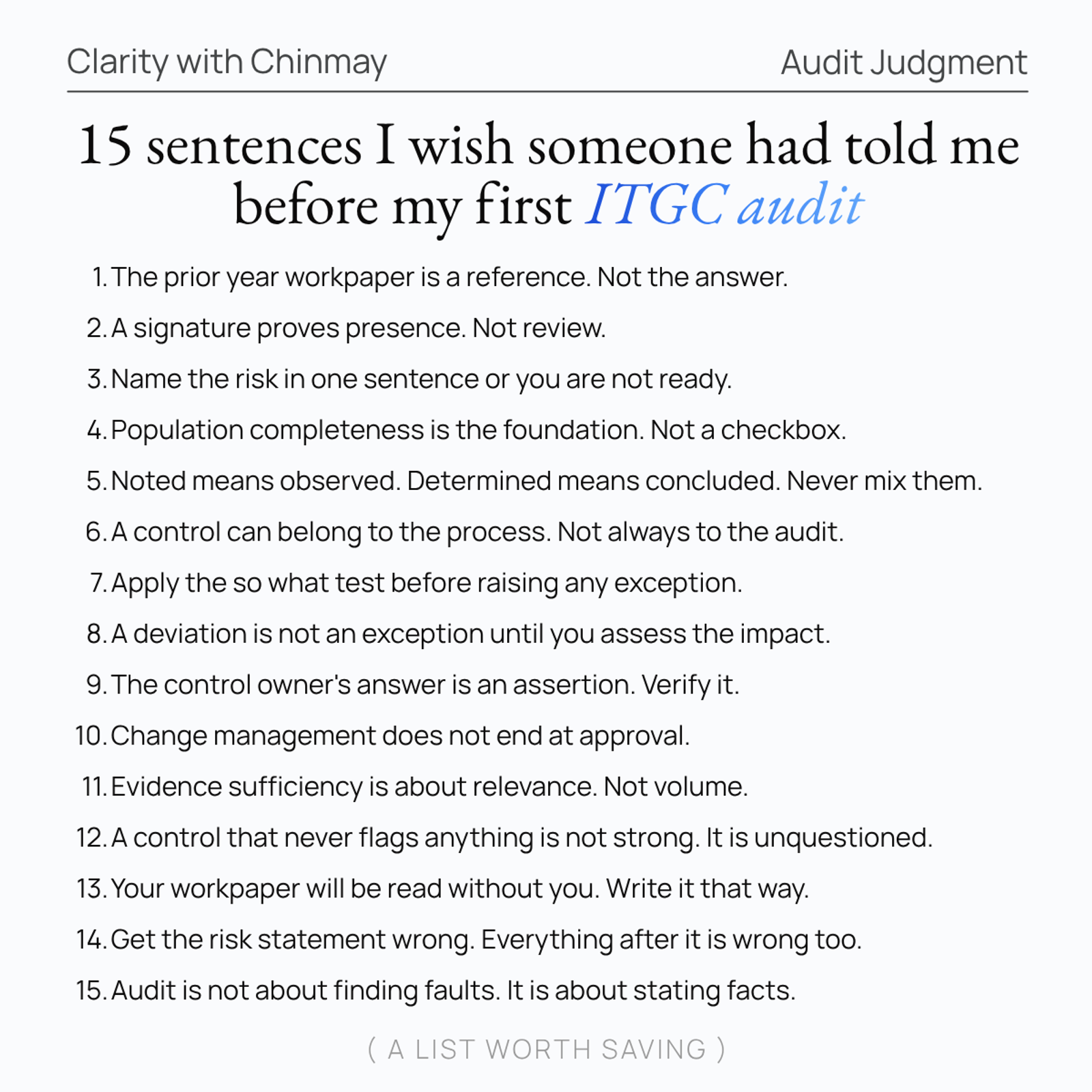
A curated list of foundational principles to help technology auditors sharpen their risk alignment, evidence verification, and workpaper writing ahead of their first ITGC audit.
Speaking, training, or a conversation about IT audit and risk. Reach out directly.
Get in Touch